sRGB
99.4%
Web and office baseline
The weakest unit in the sample reached 98.1%, so no panel fell below the working threshold. Average error across the 24-patch set: 0.8 ΔE.
Read the methodLab Report 04 — Display Subsystem
Forty-two MateBook NH panels measured on the same bench, at the same 120 cd/m² target, with the same contact spectrometer. This report records gamut coverage, white-point drift and per-patch color error before and after calibration.
42
units in the sample
99.4%
sRGB coverage, median
1.1
ΔE2000 average, calibrated
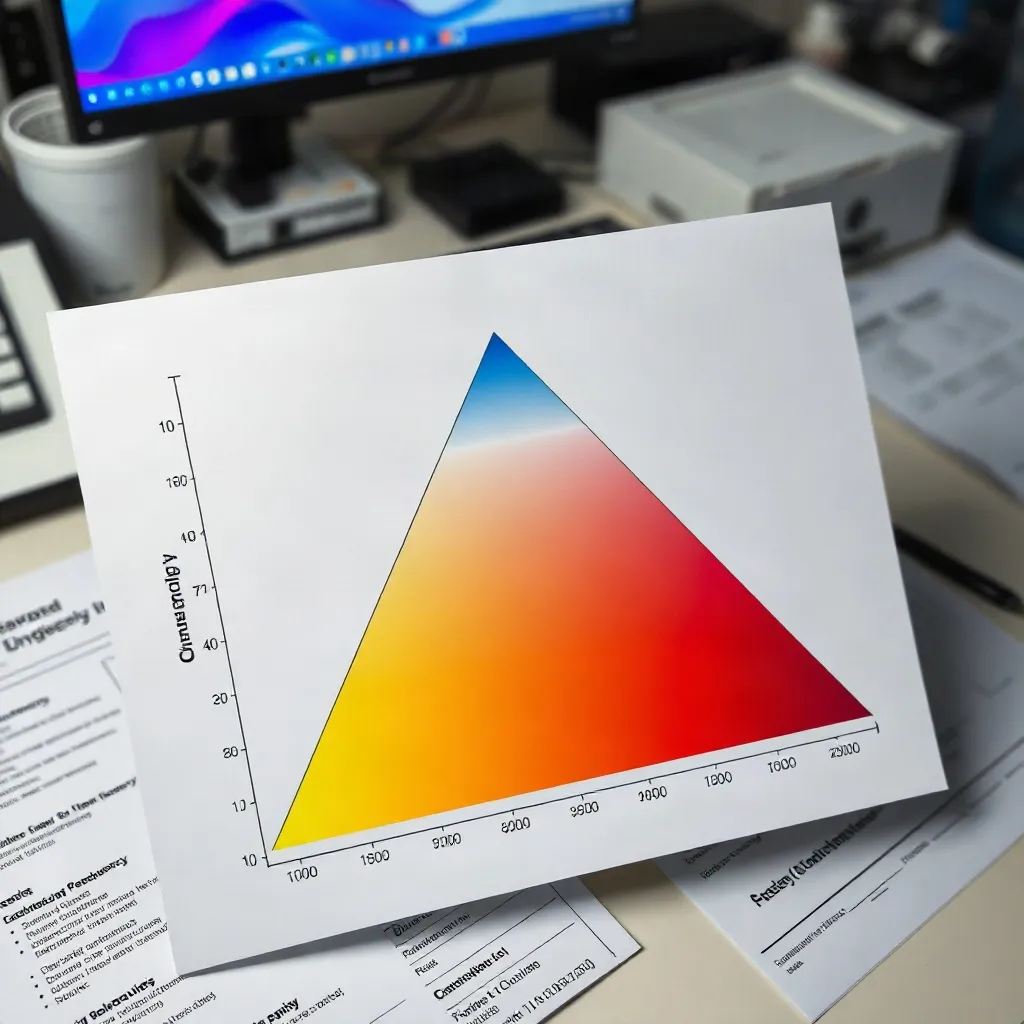
Coverage was recorded as the share of a reference volume the panel can reach at ΔE ≤ 3.0. Three spaces were tested on every unit, and the figures below are the median of the sample, not the best unit. Panel output also depends on how the platform sustains power, which we track on the ultrabook processors page.
sRGB
99.4%
The weakest unit in the sample reached 98.1%, so no panel fell below the working threshold. Average error across the 24-patch set: 0.8 ΔE.
Read the methodDCI-P3
96.2%
The green primary is the limiting factor; red and blue stay inside tolerance up to 90% saturation. Average error: 1.4 ΔE.
Verification guideAdobe RGB
88.7%
The panel does not reach the full green corner, so soft-proofing here needs a measured ICC profile, not a factory preset.
Field reviewsHypothesis: a factory profile leaves 2–4 ΔE of avoidable error on a panel of this class. The test ran the same four-step sequence on all 42 units, each step repeated twice with the readings averaged.
Dark stabilization. 40 minutes at 22 °C, display on, brightness locked at 120 cd/m².
White point and gamma. Target D65 and gamma 2.2, adjusted in the GPU LUT rather than the panel OSD.
Gamut mapping. Measured primaries written into an ICC profile with relative colorimetric intent.
Control measurement. 24 patches re-read after a 10-minute settle; the run is accepted only if maximum ΔE stays under 2.0.
Result: average ΔE dropped from 3.1 to 1.1, and the worst patch from 6.4 to 2.6. The full sequence takes 55 minutes per unit and holds within 0.2 ΔE on a repeat run.
Values below 2.0 are treated as invisible in a side-by-side comparison; above 3.0 the difference is visible on skin tones and neutral gray. Each group was read twice per unit and averaged.
Saturated blue stays the weak point of the panel. It is a hardware limit of the blue emitter, not a calibration fault — no LUT adjustment moved it below 2.4 on any unit.
All readings were taken with a contact spectrometer at the panel center, then repeated at 10% and 90% of screen width to check uniformity. Brightness uniformity varied by 6% across the sample, inside the ±10% acceptance band used in the lab. Sustained-load behavior is covered separately in the thermal cooling benchmarks.
"They measured my unit before I paid for it and showed the ΔE plot on screen. The blue error was real, and the profile they wrote fixed the skin tones in my retouching work."
— Marta Kovalenko, freelance retoucher
"Second laptop from this bench. Same procedure, same numbers within 0.2 ΔE. The report is one page and readable without a color science degree."
— Ihor Danylenko, video editor
The hypothesis held: factory presets on the MateBook NH panel leave roughly 3 ΔE of correctable error, and a four-step calibration brings the average to 1.1. sRGB coverage is effectively complete, DCI-P3 is usable for grading, Adobe RGB is not. Buyers who need print-accurate green should verify a single unit before purchase.